2025-Q3 Polkadot Treasury Report
Introduction
This is the 2025-Q3 Polkadot Treasury Report. It is part of the Treasury Report series and is an important tool for informing Polkadot stakeholders.
Key Insights
- The Balance Sheet shows 114m USD (27.8m DOT).
- On the asset side...
- 80m USD (19.5m DOT) are free for spending. 6.6m USD of the cash reserves are available as stablecoins, with an additional 3.2m DOT (13m USD) allocated to automated stablecoin acquisition.
- 25.7m USD (6.3m DOT) are earmarked for strategic initiatives such as marketing, DeFi tooling, gaming, BD, etc.
- 8.5m USD (2.1m DOT) are deployed into DeFi market operations.
- 4.6m USD (1.1m DOT) in liabilities are payable within the next 12 months
- On the asset side...
- Expenses
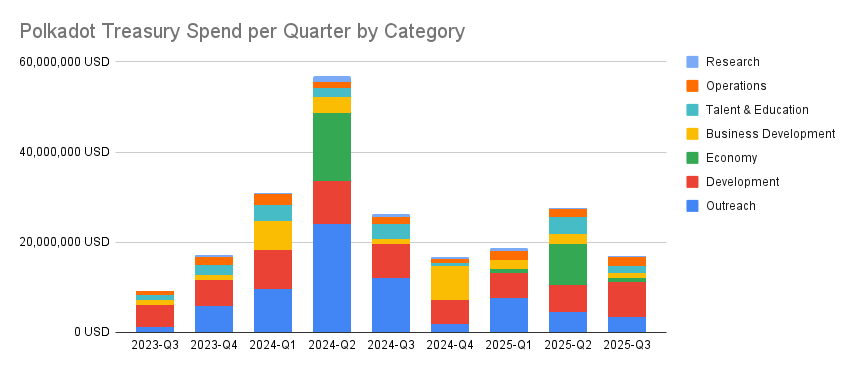
- The Treasury has spent 17m USD (4.3m DOT) in 2025-Q3. Accounting for inflation and burn, the net loss is 260k DOT.
- The top 3 spending categories were Development (7.6m USD), Outreach (3.5m USD), and Operations (2.1m USD)
- Departments (Bounties and Collectives)
- A record 36% (6.2m USD, 1.6m DOT) of the spending happened via departments.
- Stablecoins:
- 60% of all Treasury spends were done in stables
- 10.8m USD have been acquired in stables.
- 9.8m USD in stables have been spent.
- OpenGov is deploying capital into the economy: 8.5m USD are provided as liquidity into 3 different DeFi protocols
- The Polkadot Treasury has grown more conservative and focused more on essential operations and less speculative spending.
About this Report
The Polkadot DAO manages millions of USD in assets. As such, it follows accounting best practices and pioneers them for the Web3 space. This report comes with a balance sheet and income statement. The balance sheet will give a complete overview of all active accounts the Treasury manages and how assets are distributed over its operations. The income statement will break down the categories in which the Treasury spends.
We express our gratitude to the Web3 Foundation for funding this report as part of the OpenGov.Watch initiative. Thanks also to the OpenSquare team for providing an API to fetch spending data via their subsquare.io project, as well as the Parity data team for providing additional data.
Authors: Alice und Bob, Jeeper
Introduction to the Polkadot Treasury
To help newcomers to Polkadot read this report, we want to begin by offering a few ideas that guide the strategic decision-making of many voters. DAO contributors ("agents") ensure that the Treasury aligns on strategic initiatives:
- As the guiding strategic principle, Polkadot is committing to the core vision of Web3: Apps that put users back in control of the Internet! Its ecosystem has to be understood as the Polkadot Cloud. A complete stack of Web3 services that allow builders to create powerful and scalable applications and business cases at a fraction of the cost of other ecosystems.
- Polkadot is unstoppable. It sustains itself. Research, development, and operations all focus on delivering secure and resilient core Web3 infrastructure. Bridges, wallets, data services, SDKs, governance and developer tooling, and nodes are all paid for by OpenGov. As a result, the network is not dependent on external organizations.
- Polkadot's growth thesis is centered on enterprise adoption in key verticals. Its business development and market operations are focused on winning market share in (1) DeFi, RWA & Fintech, (2) Gaming & Entertainment, (3) AI & DePin, (4) Social and Identity, and (5) GovTech. Decentralized business development teams work with investors, accelerators, and ecosystem support teams to help teams onboard and succeed in Polkadot.
- Polkadot is developing its talent pool. The Polkadot Blockchain Academy provides multi-week in-person education to hundreds of founders and developers multiple times per year to provide new projects with qualified personnel. In addition, hackathons around the globe expose thousands of devs each year to Polkadot's tech stack.
- Polkadot's outreach effort is unmatched by any other DAO. From content creation in Polkadot-native media brands to distribution, to advertising. From market research to running a decentralized ambassador program and hosting and participating in global events. All of these functions are now operated by the DAO, removing the risks of single points of failure.
- OpenGov is differentiating into specialized departments, scaling up its throughput capacity. Dedicated departments composed of domain experts are forming around key ecosystem functions (e.g. marketing, FinTech integrations, etc) to streamline the processing of related proposals. This reduces the load on the main OpenGov voting tracks and allows stakeholders to focus on high-level decisions.
Balance Sheet
The balance of the Polkadot DAO at the end of 2025-Q3 comes out at 27.8m DOT / 114m USD. Accounting for liabilities, there is a surplus of 26.7m DOT / 109m USD.
Assets
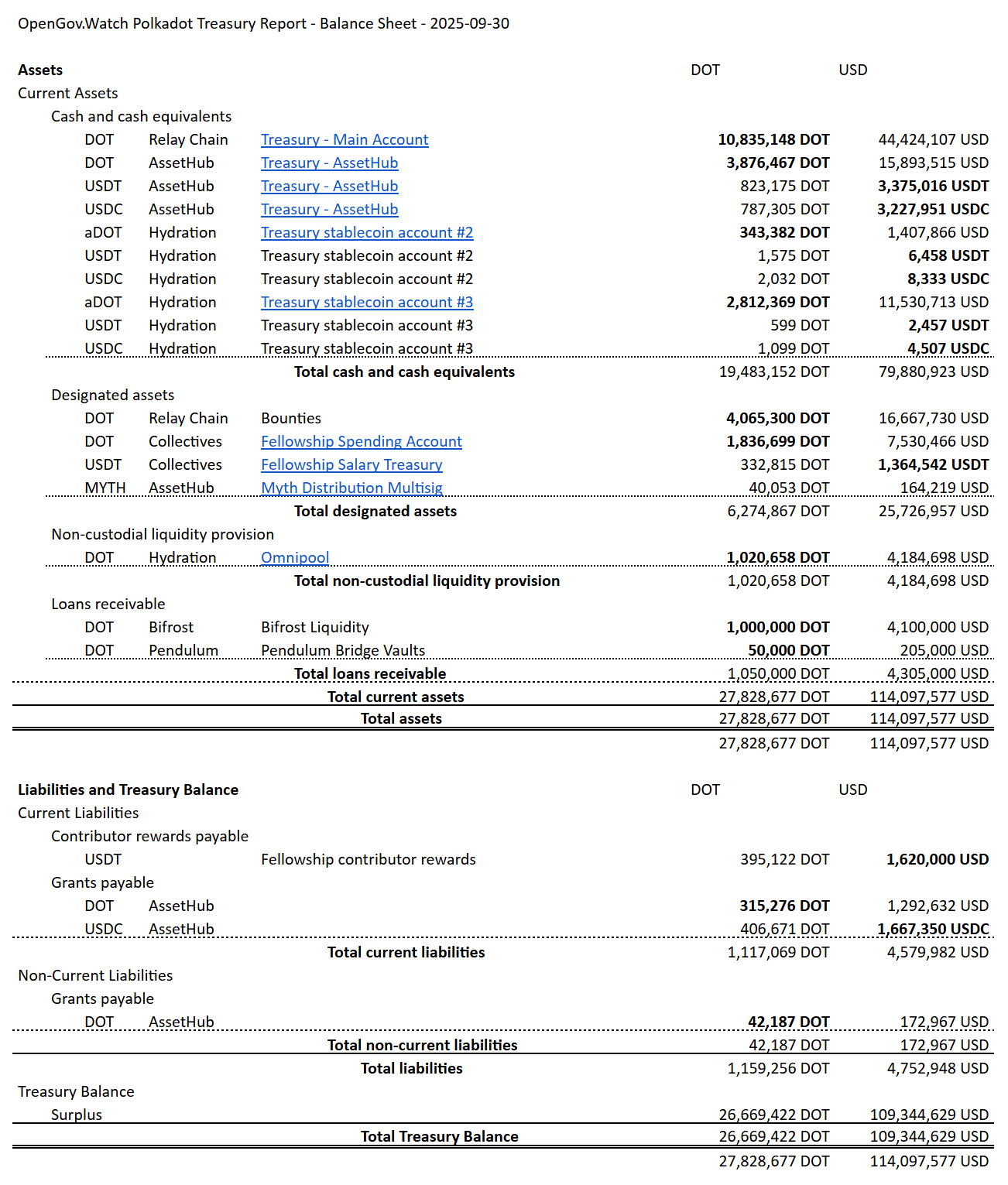
You can find the full sheet here.
Assets Structure
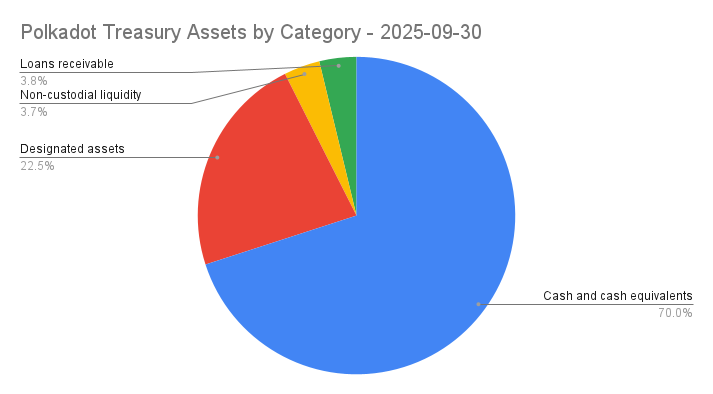
For the balance sheet, we structure the assets as follows:
- Cash and cash equivalents: 19m DOT / 80m USD
- Designated assets: 6.3m DOT / 26m USD
- Non-custodial liquidity provision: 1m DOT / 4.2m USD
- Loans receivable: 1.1m DOT / 4.3m USD
Cash and Cash Equivalents (19m DOT / 80m USD)
This category consists of DOT, USDT, and USDC which are immediately or very quickly available for the Treasury's use. Cash is held on the relay chain and AssetHub system chain.
- Relay Chain: 10.8m DOT (44m USD)
- AssetHub:
- 3.9m DOT (16m USD)
- 3.4m USDT (820k DOT)
- 3.2m USDC (790k DOT)
In addition, two trustless and fully automated stablecoin acquisition campaigns are currently running on the Hydration DeFi chain:
- Stablecoin acquisition campaign #2 still has about 340k DOT (1.4m USD) to be swapped by EOY.
- Stablecoin acquisition campaign #3 has 2.8m DOT (11.5m USD) to be swapped until 2026-Q2
Designated Assets (6.3m DOT / 26m USD)
Designated assets are assets that are under the control of OpenGov, but are already earmarked for specific duties, primarily to fund the DAOs executive bodies (bounties and collectives). In addition, Polkadot holds 164k USD in MYTH to be deployed through airdrops to DOT holders.
Bounties
Polkadot has 16.7m USD (4.1m DOT) sitting in bounties, ready to be distributed to teams that perform value-adding activities in the ecosystem. (To learn more about how to request funding, book a free consultation here)
Technical Fellowship
The Polkadot Technical Fellowship is the core maintainer of the runtime. It is funded through the DAO. The Fellowship has two accounts:
- Salary account: 1.4m USDT (330k DOT)
- Spending account: 1.8m DOT (7.5m USD)
MYTH Airdrop
As part of Polkadot's strategic partnership with Mythical, it acquired MYTH tokens in exchange for 1m DOT. 2.6m USD-equivalent of MYTH were already distributed to DOT holders and service providers. A remaining reserve of 164k USD-equivalent MYTH remains within the MYTH distribution account to be used in the future.
Non-Custodial Liquidity Provision (1m DOT / 4.2m USD)
The Treasury deploys some of its idle capital into the Polkadot economy. 1m DOT (4.2m USD) sits in the Hydration Omnipool as DOT liquidity.
Loans Receivable (1.1m DOT / 4.3m USD)
These positions are the custodial counterparts of non-custodial liquidity provision.
- Bifrost has deployed 1m DOT into its liquid staked DOT product
- Pendulum has borrowed 50k DOT for its stablecoin bridge vaults
One old position was closed: Following Ref 1122, a loan of 1.5m USDT deployed to the Centrifuge RWA Yield Pool has been returned to the Treasury through this account.
Assets Portfolio
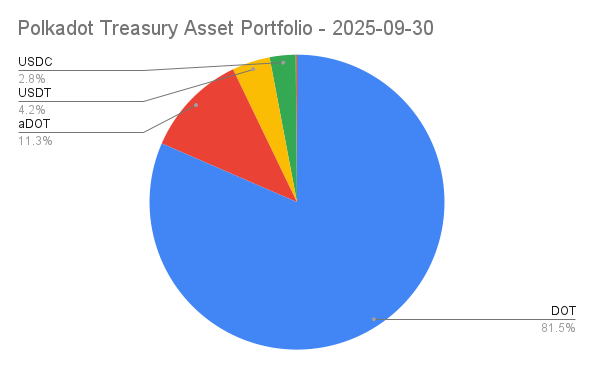
The Treasury holds DOT, aDOT (DOT provided into the Hydration money market), USDT, USDC, and MYTH. The Treasury's biggest position is in its native asset DOT, with 23m DOT (93m USD) making up 82% of the portfolio. While the Treasury is swapping DOT for stables, it keeps the DOT position in a money market to increase liquidity and earn yield. The aDOT portion of the portfolio makes up 3.2m DOT (13m USD) or 11% overall. The stablecoin portion of the Treasury is 4.2% USDC (4.7m USD) and 2.8% USDT (3.2m USD). MYTH about to be airdropped makes up 0.14% (164k USD).
Assets by Chain
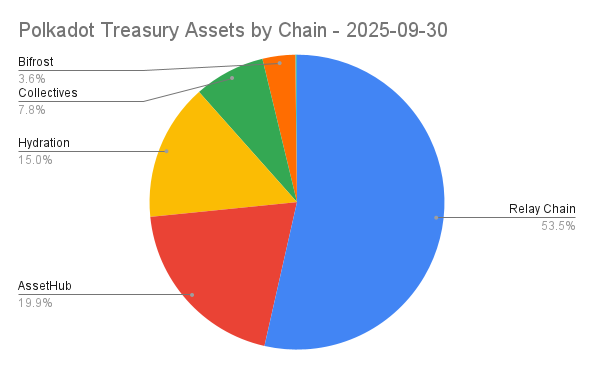
Polkadot holds assets on 6 different chains. Parachains are a significant part of the Treasury economy, with 26% of the Treasury's owned assets being deployed on various DeFi chains like Hydration (17m USD), Bifrost (4.1m USD), and Pendulum (200k USD). Polkadot Governance allows decisions to be executed trustlessly across all chains under the Polkadot security umbrella. 74% of the Treasury is held on 3 system chains to be used as free cash and for the various executive bodies.
Liabilities
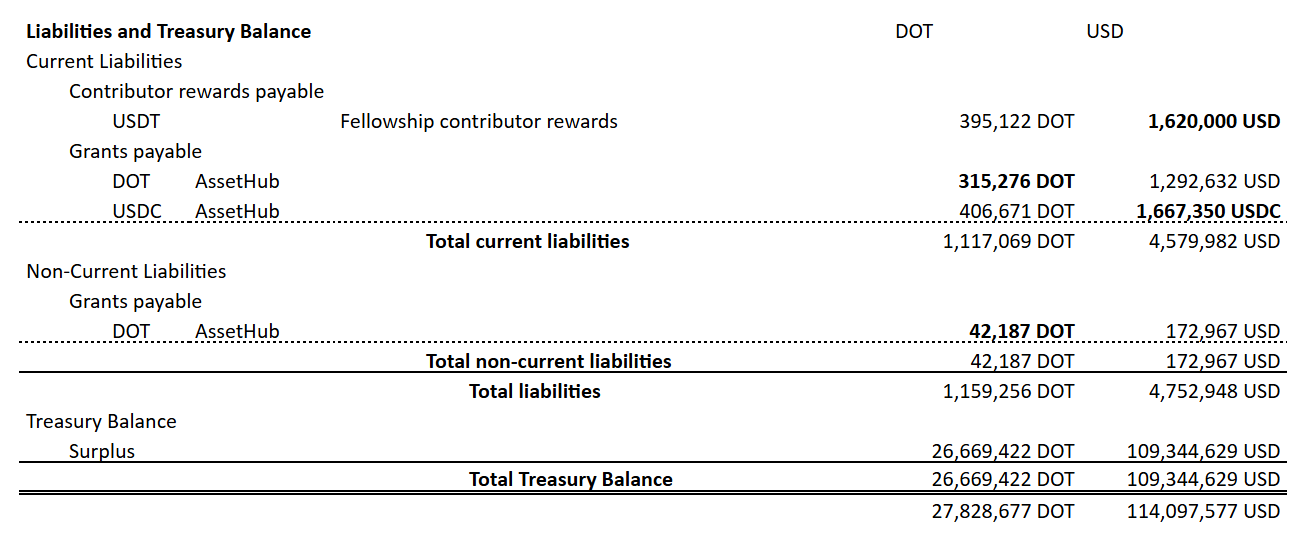
The Technical Fellowship pays a monthly allowance to members, which we file as "Contributor rewards payable". The Polkadot Treasury has also introduced a mechanism for claimable future payments. They represent liabilities. We treat them as "Grants payable" in the balance sheet.
- Current Liabilities are those owed within the next 12 months. They make up 4.6m USD (1.1m DOT)
- Contributor rewards are estimated to make up 1.6m USD (400k DOT)
- OpenGov has committed to 3m USD (720k DOT) in grants to service providers
Grants Payable
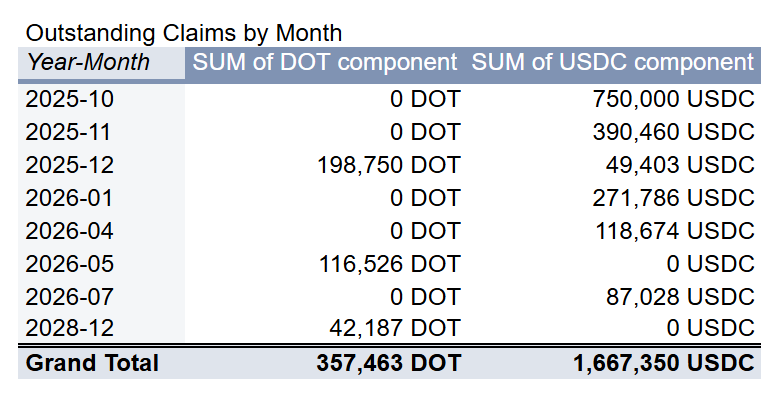
Claims on future payments have been granted to the amount of 1.7m USDC and 360k DOT.
Income Statement
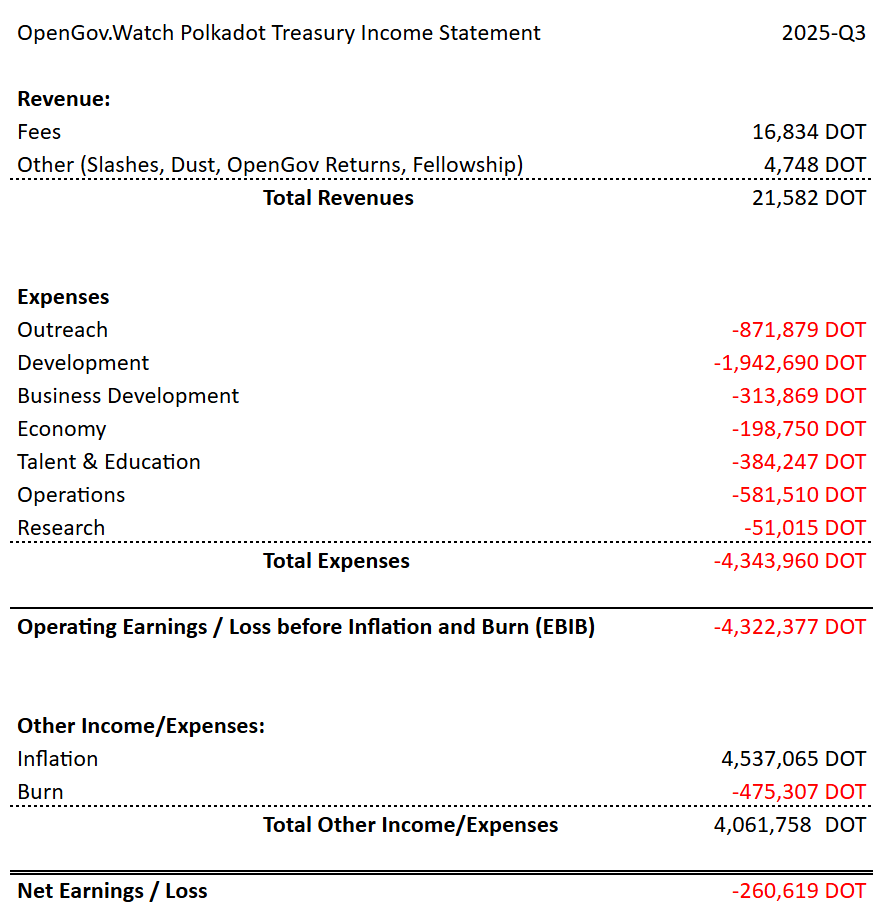
For the income statement, we use DOT as the primary unit of account, since it is the unit that the main Treasury income - inflation - is based on. For the expenses section, we will additionally provide a USD-denominated table for easier comparison.
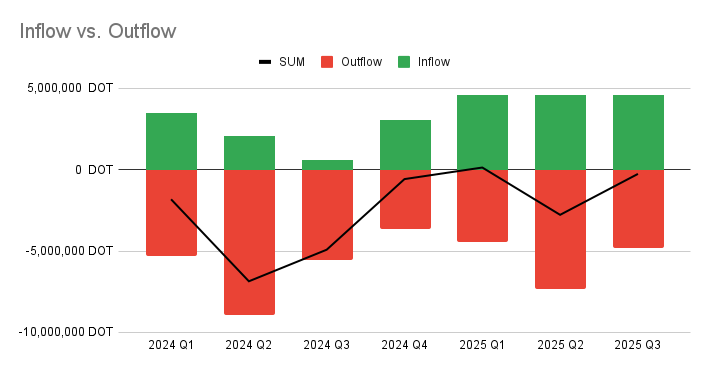
Polkadot has had expenses of 4.3m DOT (17m USD) in the third quarter of 2025. After adding revenue, inflation, and burn, the net loss was 260k DOT.
Expenses
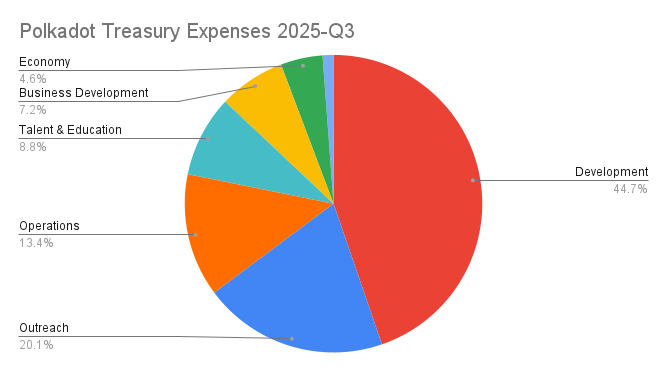
Polkadot spent 17m USD (4.3m DOT) in the third quarter of 2025. The biggest position is Development, leading with 7.6m USD (1.9m DOT). Outreach came next with 3.5m USD (870k DOT). Operations made up 2.1m USD (580k DOT). For Talent & Education, the DAO spent 1.4m USD (380k DOT). Business Development initiatives totaled 1.2m USD (310k DOT). Economic incentives were supported with 900k USD (200k DOT). 190k USD (51k DOT) were spent on Research.
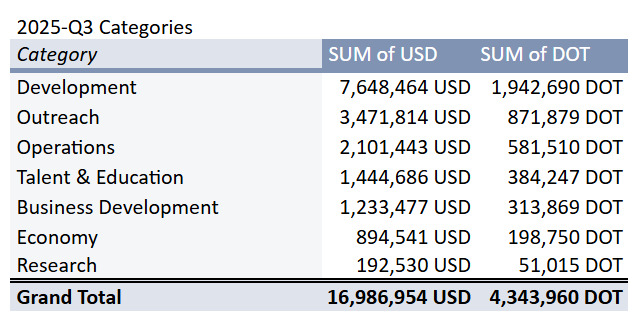
We will dig into the details below, but before we do so, let's look at what categories Polkadot spends money on.
Categories
The categories and subcategories in this report have been selected by our team:
- Research: Security, Governance, Anti-Scam efforts, reports, and analytics, UX & DX
- Development: The Polkadot protocol and its core SDKs, Bridges, Wallets, data services & indexers, SDKs, Governance tooling smart contracts, and various other technologies
- Operations: software, hardware, and service costs incurred to operate the network (RPCs, archive nodes), auxiliary services (explorers, indexers), and legal costs (foundations)
- Outreach (Marketing, BD, Community Development): Marketing (media production, PR, advertising) and community development (conference hosting, conference attendance, local outreach, events, community building, ambassador program)
- Business development: developing verticals like gaming, DeFi integrations, GovTech, music industry solutions, consulting, solution architecture, DevRel
- Talent & Education: education, hackathons, recruiting, and talent incubation through the Polkadot Blockchain Academy
- Economy: Liquidity Incentives to stimulate the economy
Spending Overview
The Treasury has become more conservative in Q3, with Development being the only bigger position. Outreach was significantly below average.
Now let's dive a bit into the individual categories!
Development
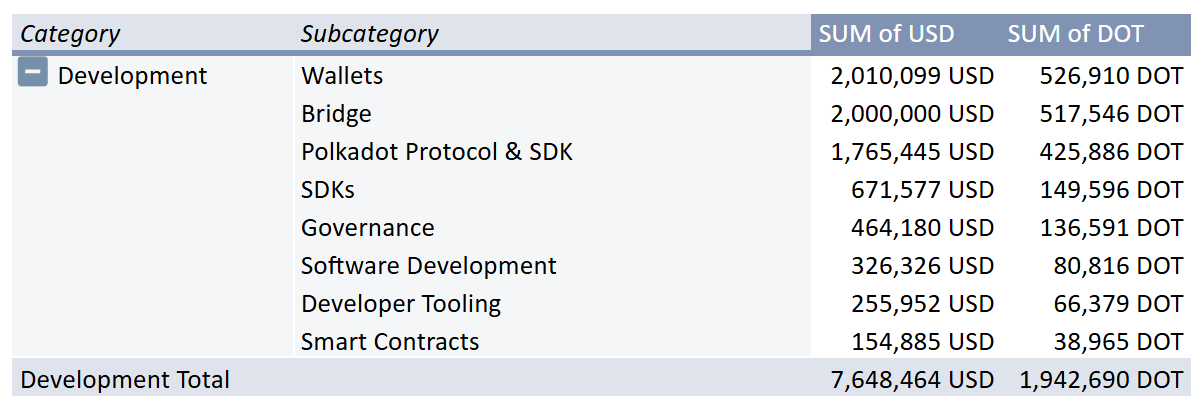
Development (7.6m USD) covers software development specifically for the core Polkadot infrastructure and tools necessary to operate and interact with the network.
Wallets (2m USD) covered 1m USD each for the upcoming Polkadot App and Nova Wallet development. Bridge (2m USD) funded the continued development of Snowbridge. Polkadot Protocol & SDK (1.8m USD) includes positions such as 430k USD for the development of PVQ (formerly XCQ), a new query language for cross-chain communication, 340k USD for Fellowship contributor rewards, 300k for a Java host implementation of Polkdaot, and 290k and 280k for two different teams contributoing to the Polkadot SDK.
SDKs (680k USD) consists of 580k USD for Pop CLI and 90k k for ReactiveDOT. Governance (460k USD) funded the development of Subsquare (440k USD) and two smaller new governance tools. Software Development (330k USD) supported Pixelproof (230k USD), RegionX (50k USD) and Opentribe (30k USD). Developer Tooling (260k USD) funded ParaSpell (150k USD) and dAppForge (110k USD). Smart Contracts (150k USD)
Outreach
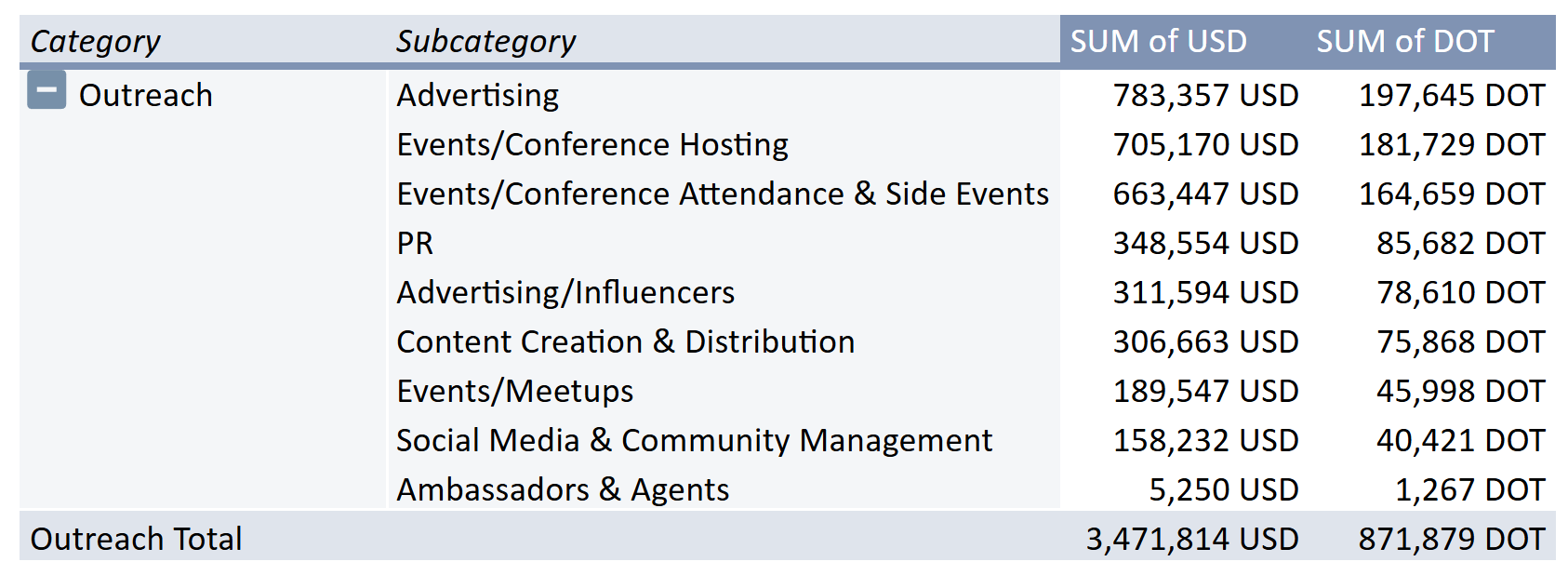
3.5m USD was spent on outreach for marketing, events, and community building. The Outreach category contains also sub-subcategories. The most relevant clusters are around events and advertising. We will start by looking at them individually.

Costs for Events (1.6m USD) are split up between hosting conferences, attending conferences, hosting side events to conferences and funding smaller meetups.
Conference Hosting (710k) covers the cost for sub0, Polkadot's flagship conference in Buenos AIres this year. Conference Attendance & Side Events (670k USD) covered the Token2049 Singapore side event (140k USD), TechCrunch 2025 (110k USD) and Coinfest 2025 (100k) attendance and a dozen more events.
Meetups (190k USD) funded close to 100 events around the globe.

Advertising (1.1m USD) funds advertising for Polkadot and teams working in Polkadot. Nova Wallet's Novashots prediction market was supported with 240k USD. A coins.ph marketing campaign was funded with 72k USD. Two DeFi Bounty integrations together received 70k, likely for their Asset Hub launch campaigns. The Polkadot App Launch advertising campaign received funding of 54k USD.
Kaito Influencing received 310k USD.
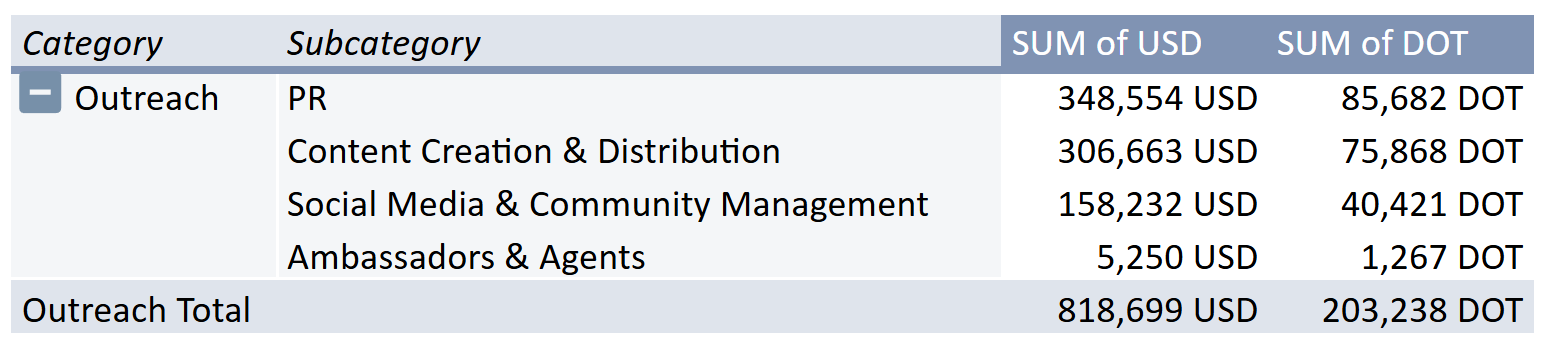
PR, Content, Socials, Community, and Agents (820k) form the remainder of the spends in Outreach. In PR (350k USD), we have our agencies Serotonin (270k USD) and Distractive (68k USD). Content Creation & Distribution (310k USD) consisted of 220k USD) for The Kus and 54k USD for Pala Labs' JAM Tour Documentary.
In Social Media & Community Management (160k USD), the DAO funded the community team with 100k USD, the Social Media Edutorial Board (35k USD) and the Community Management Treasury (15k USD). Agents received 5k USD in compesantion for representative activities.
Operations
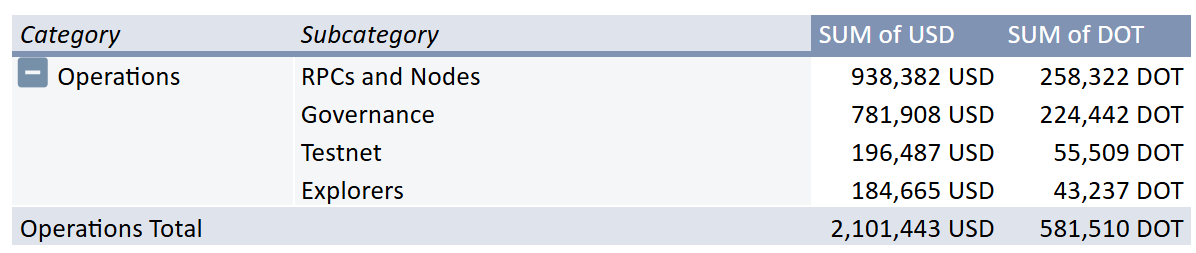
Operations (2.1m USD) covers software and hardware essential to operate the network.
RPCs were funded with 940k USD. Under Governance (780k USD), the Polkadot Community Foundation (630k USD) was renewed for another year, and JUST received 150k USD for their Governance work. Running the Testnet Paseo cost 200k USD and 3 quarters of Subscan explorer was supported with 180k USD.
Talent & Education

Talent & Education (1.4m USD) covers costs associated with growing the Polkadot talent pool.
The Polkadot Blockchain Academy was funded with 730k USD for campus cohort 7, The JAM course launch, a university pilot, PBA-X, and the Alumni program. Developer Onboarding (540k USD) covered region specific teams with OneBlock+ (380k) for APAC and 160k for Polkadot Africa. Hackathons (180k USD) contained LATIN Hack (87k USD) and the Polkadot 2.0 Global Hackathon (33k USD) as well regional hackathon meetups.
In Hackathons (550k USD), EasyA (395k USD), Encode Club (130k USD), Goa 2025 (26k USD) got funded. In Developer Tooling & Onboarding, OpenGuild was granted 290k USD to accelerate Polkadot Builder Activation in SEA & Broader Asia
Business Development
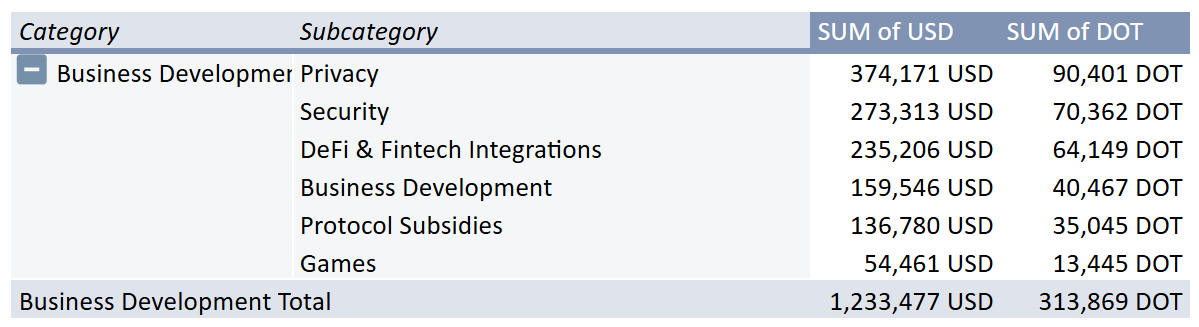
Business Development (1.2m USD) efforts focused on market penetration of several verticals, as well as funding niche-specific tech and experiments.
A Privacy (370k) grant went to Peer3 SDK for peer-to-peer smart contracts. Security (270k USD) registers audits for Moonbeam (93k USD) and Xcavate (70k USD). DeFi & Fintech Integrations (240k USD) supported integrations like USDC for Chainflip (140k USD) and coins.ph (51k USD). In the general Business Development (160k USD) subcategory, we see PolkaBiz got funded with 62k USD, a partnership with the Politechnico Milano (59k USD), and Hong Kong's Office for Attracting Strategic Enterprises (36k USD). Protocol Subsidies of 140k USD went to Cyborg Network. The Games Bounty paid out 55k USD.
Economy

Economy (900k USD) supported the next phase of the DeFi Singularity with 200k DOT.
Research
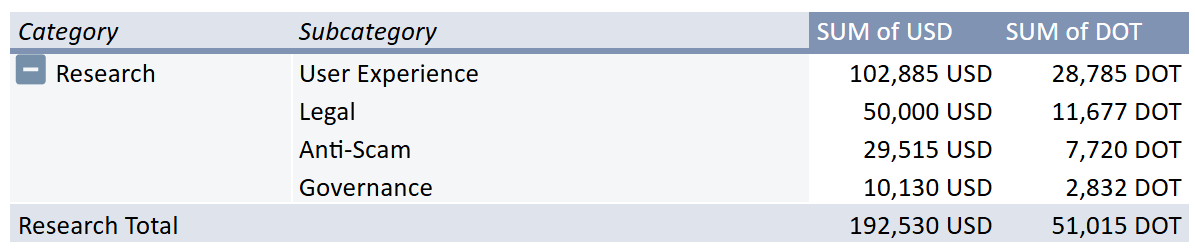
Research (190k USD) funds projects that are experimental, research-driven, or surface new data.
The User Experience (100k USD) subcategory contains UX audits (28k USD) and a grant for Turtle (24k USD). A Legal (50k) project to understand US DAO wrappers was funded as Polkadot.law. The Anti-Scam bounty charged 30k USD and OpenGov Research was funded with 10k USD.
Departments (Bounties & Collectives)
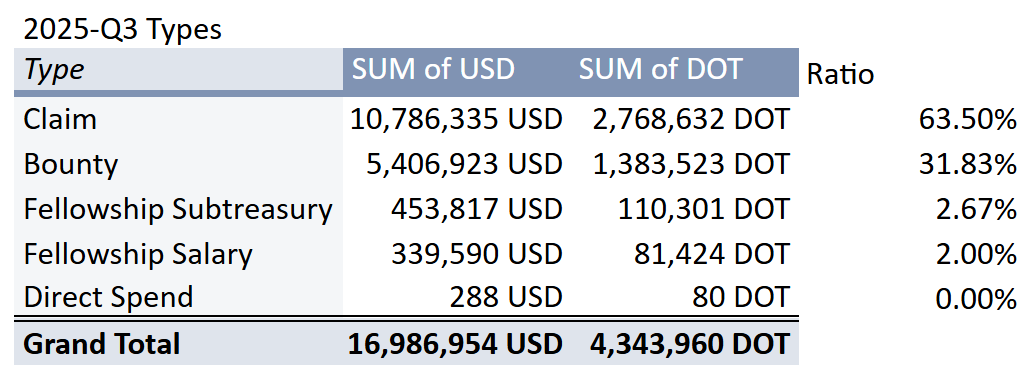
Departments, (sometimes also referred to as executive bodies) are set up to provide a service in a certain area of the ecosystem. They simplify OpenGov by bundling work in a certain area, reducing mental load and volume on the general voting tracks. Since 2024-Q3, executive bodies have processed ~21% of the total spending, in 2025-Q3 the ratio was 37%. Keep in mind that these costs were already represented in the previous chapters and this is just a different perspective to represent them.
Bounties
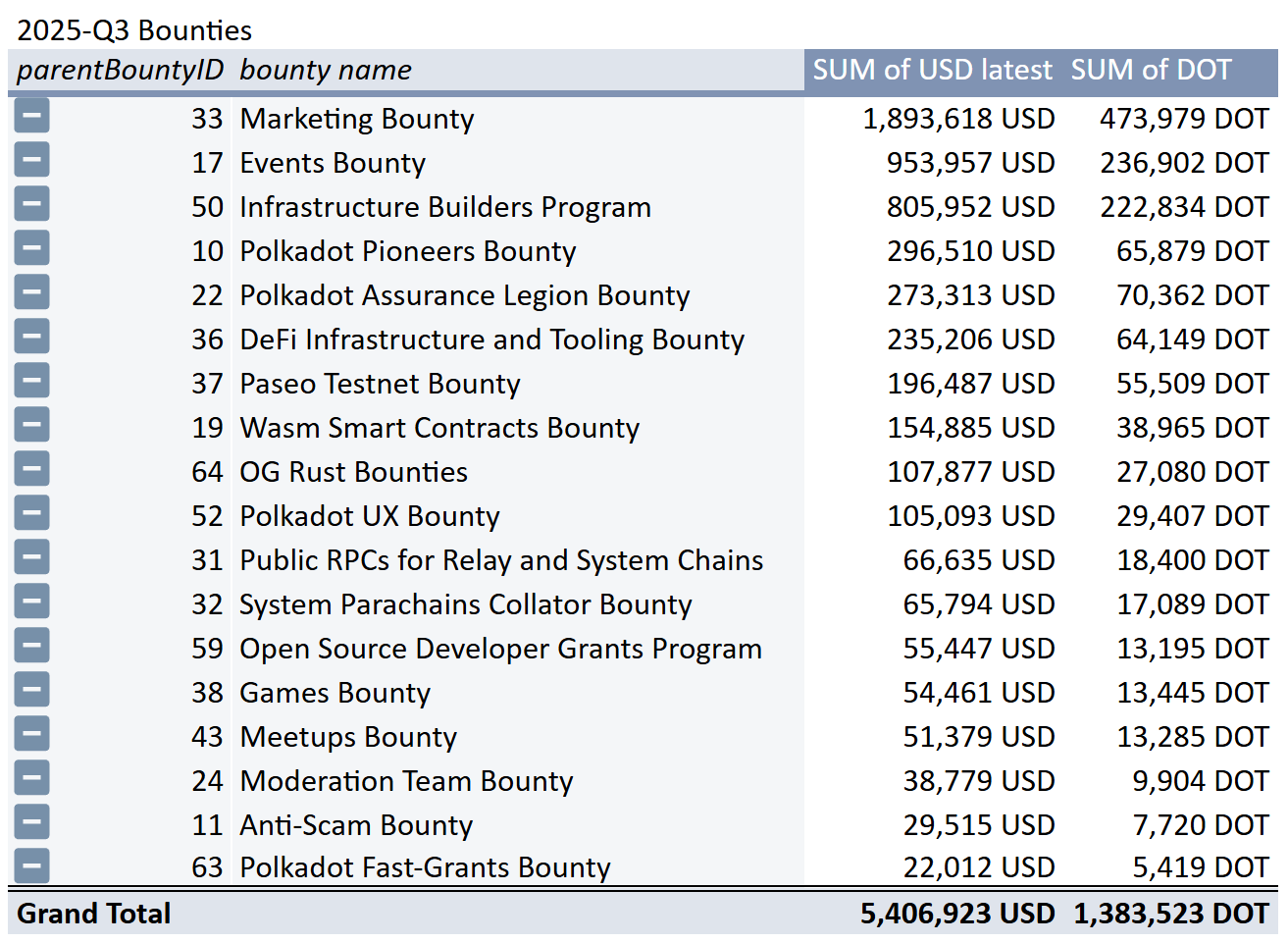
Bounties are similar to departments in traditional organizations. Bounties have a specific mandate to spend money to achieve certain goals. Collectively, Bounties spent 5.4m USD, 32% of the total expenses in 2025-Q3. On top, we have the Marketing (1.9m USD) and Events (950k USD) bounties, focusing on outreach. The Infrastructure Builders Program operates crucial node infrastructure, costing 810k USD. The Polkadot Pioneers Bounty paid out 300k USD for Java Host implementation of Polkadot. The Polkadot Assurance Legion provided security audits for 270k USD. DeFi Infrastructure and Tooling (240k USD) focuses onboarding of financial services to the Polkadot Hub. Paseo did cost 200k USD in the third quarter of 2025. The Wasm Smart Contracts Bounty spent 150k USD.
Collectives
For the technical Fellowship, the following salary costs have accrued:
- 2025-07: 103k USD
- 2025-08: 115k USD
- 2025-09: 121k USD
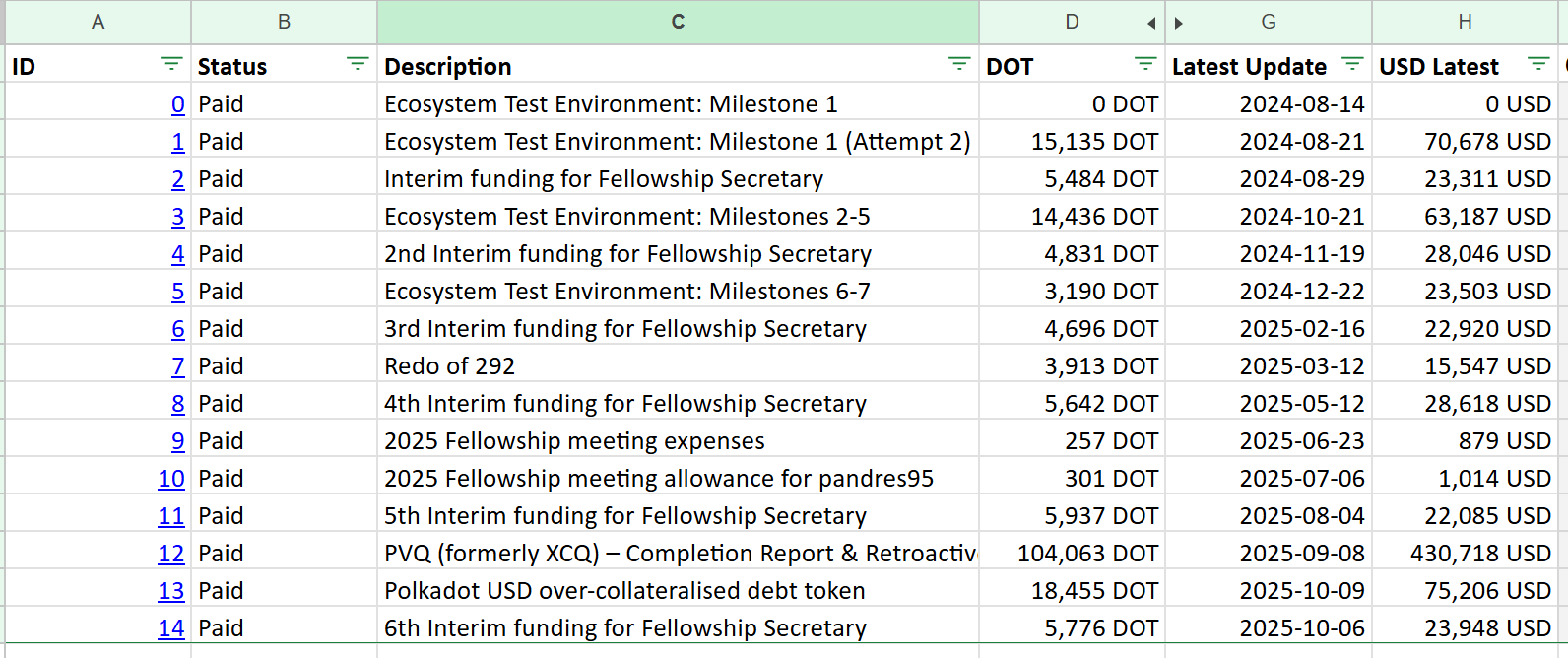
In 2025-Q3, the Fellowship Subtreasury paid out three positions, resulting in 450k USD spending.
Analysis
Stablecoins
In this chapter, we want to look at the historic and projected stablecoin flows.
Historic Stablecoin Flows
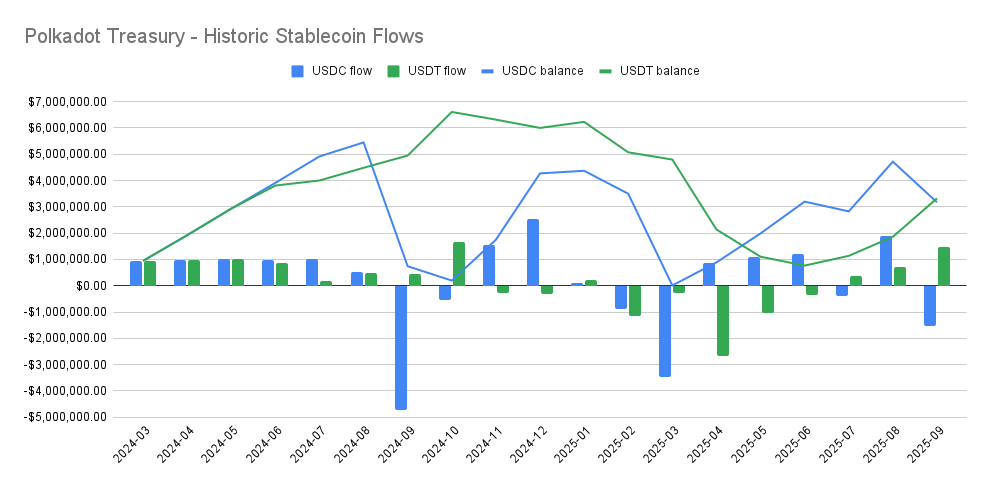
In total, the Treasury has been accumulating 26m USDC and 26m USDT from 2024-03 until the end of 2025-Q3. Currently at a rate of 1.8m USD each per month.
Spending has been keeping pace with inflows, with 26m USDC and 23m USDT going to proposers.
Stablecoin acquisition campaign #3 has started in 2025-Q2 and will lead to an inflow of 2.8m USD in stables per month.
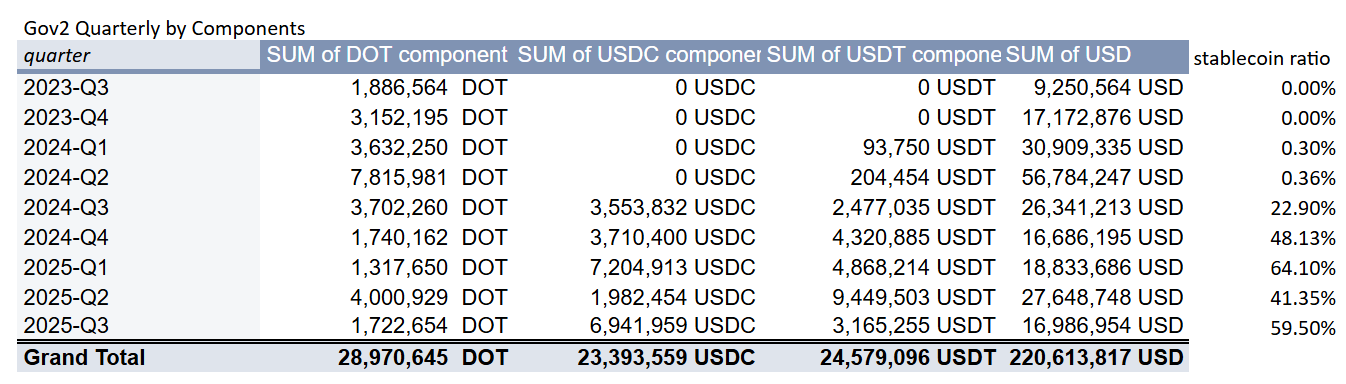
Below you see a breakdown of how much has been spent per quarter in DOT, USDC, and USDT, as well as the USD-equivalent of the whole quarter and the ratio of how many stables have been part of the spend per quarter.
Trend
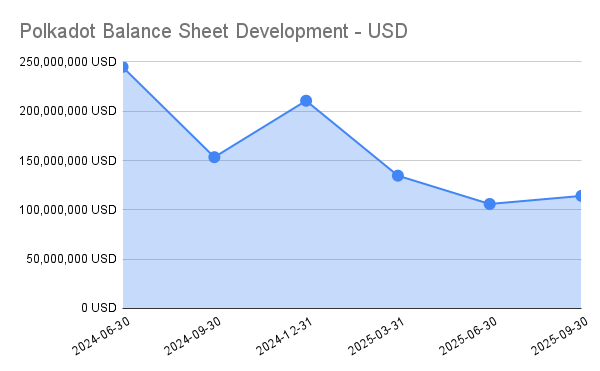
In the long-term trend, we can see that the DOT-denominated balance and cash are trending sidew.ays Since the Treasury is still very heavy on DOT, the overall Treasury value still correlates strongly with the DOT price.
Balance Sheet Development
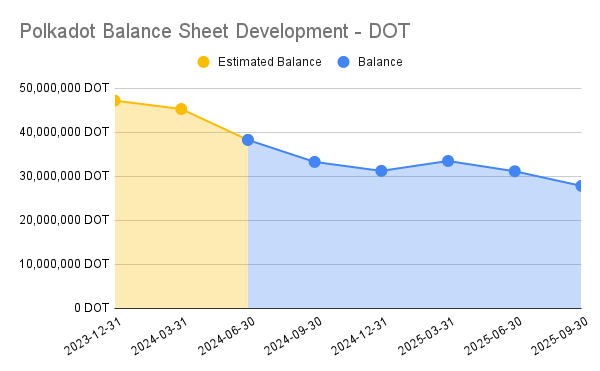
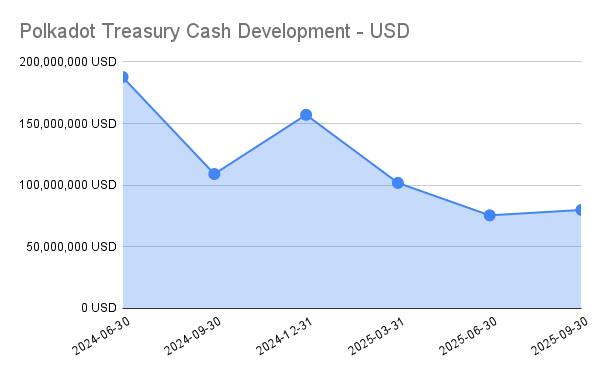
This quarter removed 2.7m DOT from the balance sheet. The Treasury correlation with the DOT price becomes visible in the USD chart, showing an increase in the USD valuation:
Treasury Cash Development
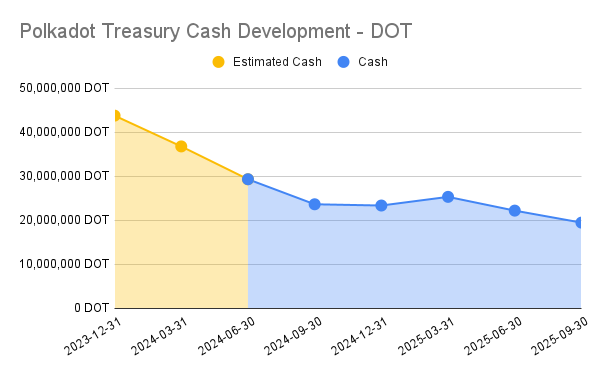
In terms of cash, we see a similar development as with the total balance, which indicates that the overall spending behavior stayed consistent with previous quarters.
Notes
- Code
- The raw data for this report can be found in the following places:
- For ease of readability we generally round to the two most significant digits.
- Data Acquisition Methodology
- We extend our thanks to the Subsquare, the Parity data team, and lolmcshizz for providing valuable data and inputs for this report.
- Balance sheet values
- intra-day exchange rates for DOT and MYTH were retrieved on 2025-09-30 from Coingecko
- token holdings on accounts were retrieved via Subscan
- The DOT amount in the Hydration Omnipool is retrieved from the Hydration UI
- Outstanding curator rewards payable are retrieved from the SubSquare collectives UI
- Bounty holdings are retrieved from SubSquare
- Income Statement
- Referenda, Treasury Spends, Child Bounties, and Fellowship Subtreasury spends were fetched through Subsquare's API
- Determination of DOT and USD values
- We do deep inspection of calls to build a bag of different assets.
- For a given date, the bags value in DOT or USD equivalent is then calculated according to market rates at those days
- Bounty and XCM send values are assumed 0. Typically they just move DOT into designated accounts and later spending can then be recognized independently
- batch calls are traversed
- Determination of DOT and USD values
- Full bounty spend: Two instances in the relevant timeframe is recorded. These were manually taken from Subscan
- Collective spend DOT values are approximated by taking the DOTUSD price in the middle of the period.
- Inflation, Burn, Fees, and other values have been provided on a monthly basis by the Parity data team.
- The Treasury got gifted several memecoins, which we currently do not consider sellable, thus valuing them 0.
- We use the following guiding principles to assign categories:
- Categories are assigned by where the primary effect of the spending will unfold its value. Titles and descriptions are less relevant here than the list of actual deliverables.
- We consider the perspective of the Polkadot ecosystem. Does it affect core technologies or is it application-specific?
- There are proposals that could belong to multiple categories. We choose the category where the majority of the costs go to.
- Referenda, Treasury Spends, Child Bounties, and Fellowship Subtreasury spends were fetched through Subsquare's API
- The report uses cash accounting (for the most part)
- This means that expenses and income are considered when money changes accounts, not when the actual service is delivered.
- We strive to arrive at accrual accounting, as it is more in line with international accounting practices. But we lack the necessary team capacity and data from spends and bounties.
- Cash accounting can create distortions, for example when payments are made that extend over the measurement period, or when transactions (like the Myth swap or the Inter Miami deal) are prepaid but not yet executed (and might still fail and get refunded). Another example is the new spend() extrinsic, which we account for at the time of referendum execution.
- The current report bases its numbers on the execution date of proposals, which can deviate from the time tokens are spent. For past reporting, we only represented direct spending from the Treasury and it was convenient to represent them on the date of spending.
- Expenses
- Loans and liquidity provisions are not represented in the income statement, as they do not count as expenses per accounting standards. They will show up on the balance sheet
- Bounty creation & bounty refills are also hidden since these are not yet expended but rather become designated assets. Once they are spent via child bounties (or in a single instance fully), expenses are accounted.
- Refunds: We record income from transfers to the Treasury. These transactions are most likely refunds from OpenGov proposers that have been overpaid or decided not to deliver. However, tracking the origin of these transactions is out of the scope of this report.
- Limitations
- we can't track bounty spends if the bounty decides to liquidate to fiat to retain value. this leads to a spend being recorded at the time of liquidation
- similarly, the Marketing Bounty moved some funds to the Polkadot Community Foundation. They are not tracked after leaving the bounty main account and are counted as expenses. We will improve this in future reports.
- This report is created by humans and might contain errors. Don't trust, verify.